
Courage
You can act while afraid, and each time you move toward what matters with the fear still there, it gets more doable.
What it is
Courage, as psychologists study it, means acting toward something worthwhile while feeling afraid. It does not require feeling calm. The fear may be of physical danger, though for most people it is closer to home: saying what you think, asking for something, starting a thing you might fail at, letting someone see you. The body responds in much the same way to all of these.
It matters because fear points at what you care about as often as it points at danger. If you wait for the fear to pass before you act, you may wait for years, and avoiding the thing teaches your mind that it was right to be afraid. Approaching in manageable steps teaches the opposite, and confidence tends to follow once you have done the thing a few times.
What the research says
Approaching what you fear reduces the fear over time
Decades of clinical trials show that repeated, planned contact with a feared situation reduces anxiety, and it is the core of the best treatments for phobias, panic and social anxiety. The current view is that you learn a new expectation that competes with the old fear. The old one is not erased.
Craske, M. G., Treanor, M., Conway, C. C., Zbozinek, T., & Vervliet, B. (2014). Maximizing exposure therapy: An inhibitory learning approach. Behaviour Research and Therapy.
Doing a hard thing successfully is the strongest source of confidence
Albert Bandura proposed that belief in your ability to handle something grows mainly from having handled it, more than from encouragement or watching others. This has been supported across many fields, including treatment of phobias, education and sport.
Bandura, A. (1977). Self-efficacy: Toward a unifying theory of behavioral change. Psychological Review.
Courageous people feel fear and act anyway
Stanley Rachman studied bomb disposal operators and trainee paratroopers. Most reported fear before their work and carried it out regardless, and fear dropped with training and repeated practice. These were observational studies of selected groups, so they describe more than they prove.
Rachman, S. J. (1990). Fear and Courage (2nd ed.). W. H. Freeman.
Over a lifetime, people regret what they did not do more than what they did
In surveys and interviews, people asked about their biggest regrets named things left undone more often than mistakes of action. In the short term the pattern reverses and actions sting more. The finding depends on how regret is asked about and has been less clear in some later studies.
Gilovich, T., & Medvec, V. H. (1995). The experience of regret: What, when, and why. Psychological Review.
What to do
Name what the fear is guarding
Write down the thing you keep putting off because it scares you. Then write what you would gain or protect by doing it. Fear is easier to carry when you know what it is for.
Values compass →Build a ladder
Break the frightening thing into steps from mildly uncomfortable to hardest. Start low and repeat each step until it gets easier, then move up. You are aiming for steady practice at a level that stretches you.
Fear ladder →Write your prediction first
Before you take a step, note what you expect to happen and how bad you expect it to be. Afterward, write what happened. The gap between the two is where the learning is.
Decide the first move in advance
Fear is loudest just before you start. Make an exact plan for the first ten seconds: when the meeting opens for questions, I will raise my hand. Once you have begun, continuing is easier.
If-then plans →Act opposite to the urge to hide
When the fear does not fit the facts, do the reverse of what it tells you. Stay in the room, make eye contact, send the message. Do it fully, with your posture and voice as well.
Opposite action →Let the body be loud
A fast heart and shaky hands mean your body is getting ready. You can slow your breathing a little and still go ahead. You do not need to be calm first.
Slow breathing →Where it goes wrong
- Jumping to the top of the ladder. A step that overwhelms you can leave you less willing to try again. Pick steps that are hard and doable.
- Confusing courage with recklessness. Some fears are accurate. The question to settle is whether the risk is real and whether the aim is worth it.
- Going through the motions while holding back. If you attend the party and stand by the wall with your phone, you learn less than if you speak to one person.
A film on this
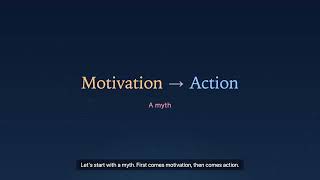 Act first, and do what you sayMotivation often follows action. A smaller, kinder way to close the gap between what you say you will do and what you do.
Sources
- Craske, M. G., Treanor, M., Conway, C. C., Zbozinek, T., & Vervliet, B. (2014). Maximizing exposure therapy: An inhibitory learning approach. Behaviour Research and Therapy.
- Bandura, A. (1977). Self-efficacy: Toward a unifying theory of behavioral change. Psychological Review.
- Rachman, S. J. (1990). Fear and Courage (2nd ed.). W. H. Freeman.
- Gilovich, T., & Medvec, V. H. (1995). The experience of regret: What, when, and why. Psychological Review.